
Two Harmonious Chords and a Dissonant Note at San Francisco Ballet

Selma Jeanne Cohen once wisely wrote: “To Balanchine, a ballet is like a rose: you look at it, and you delight in it, but you don’t ask what it means. Balanchine’s explanation for the variety of forms his roses have taken is always the same: the music.” But a ballet is never just a ballet. It is inevitably tangled up in its own history, inspiration, and all that it points towards. No matter how brilliant its succession of orchestrated steps, it cannot escape its impression when it lands in a time far from its creation.
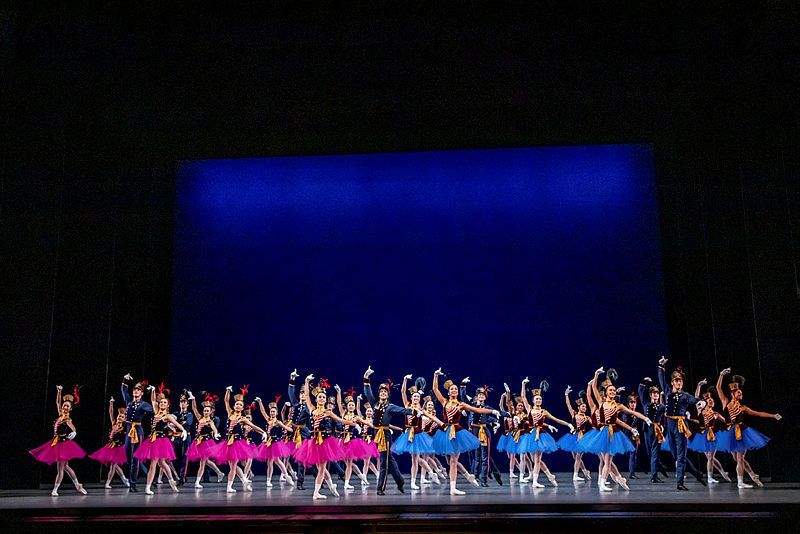
San Francisco Ballet’s second program of the season is one that, hypothetically, should be a triumphant one, for it shows the path of George Balanchine’s career from the Imperial Theatre of St. Petersburg to a proud American visionary. Diamonds, created in 1967, is an homage to Balanchine’s Russian roots, and echoes the highest strivings of classical ballet. The core of the program and the oldest of the three is Serenade, Balanchine’s first work created in the United States and one of his most sacred and beloved works. But it is the program’s final work, 1958’s Stars and Stripes, with its bravura American pride and glorified pseudo-military, which sours the program’s intentions.
As much as ballet is an escape, the outside world inevitably cannot be locked outside the theater’s doors. Twenty-five years after George Balanchine landed in New York, the constructed vision of simplified national pride seen in Stars and Stripes, in the context of its Cold War-era birth, claimed an undiminishable strength amidst John Philip Sousa’s relentless vim. San Francisco Ballet last performed Stars and Stripes in 2009, opening one day after Barack Obama’s inauguration. What was once a celebration of high-flung leg and exuberance claiming the country’s bright future, now rings in a very different hue. During curtain call, dancers held flags from a plethora of nations, and yet it was too late, the patriotic tang had already pulled us away from the brilliant intricacies of Balanchine’s divise.
Meanwhile, Serenade will always be a sacred choice. It could hold its own as the only program of the night, and we would still leave refreshed, inspired, uplifted into that realm of light and mystery. It is filled with a spiritual breath from the moment the curtain rises to reveal a hushed blue scene of hands raised to block the light. The isolated movements that stir them from stillness–a lift of the wrist, an encircled heart, the simple beauty of a stage full of a single tendu–the simplicity lets us see these steps in clarified form before they spring to life.
On March 14, 1934, George Balanchine told his cobbled-together first group of American students, “Today, I think I’ll make a little something.” From those first modest words to his last revisions in 1981, it is the work he returned to more than any other, tweaking and perfecting the ballet until each strand of Tchaikovsky’s score was fully visible.
Tchaikovsky composed Serenade for String Orchestra in Four Movements “accidentally” and “out of an inner urge”. He later referred to it as his “favorite child”, similar to how Balanchine may have viewed this work that broke open the gates of possibility for his American career and group of fledgling dancers. Balanchine made it well known that he sensed Tchaikovsky’s collaboration when he choreographed to his music, that he could turn to the music for help and find within it a guiding communication from Tchaikovsky himself. Perhaps because of its spiritual perfume, Serenade is a work whose veil is particularly thin, where Balanchine and Tchaikovsky seem to weave the work simultaneously into harmonious communion. And what a swelling communion it is; timeless wonders everywhere.

Serenade served as a foundation for Balanchine’s first students, and the work's emphasis on simplicity and pattern reveals his intention to show these variably experienced dancers how the fundamentals of their ballet vocabulary could be strung together to create motifs and visually fascinating unfoldings. Over 90 years after Serenade’s creation, the pure invention of its most brilliant phrases is still an ingenious novelty. Connected limbs that seamlessly and softly knit bodies together, the exactitude of his planning that lets patterns twist until they click into unforeseen places, the Dark Angel’s winged arms that turn three dancers into a recreation of Antonio Canova’s Psyche Revived by Cupid’s Kiss, is all so effortlessly brilliant that it seems to dwell on a different plane of existence.
In a 1971 souvenir program, Lincoln Kirstein wrote: “If there is a star, perhaps it is the corps de ballet, which Balanchine, at the start of his American career, intended to strengthen past anonymity or any subordinate position.” Serenade’s first light shows us what Balanchine wished to depart upon his newly-formed group. There is an equanimity in the way the stage ebbs and flows, dancers arrive and depart as seamlessly as a tide. One can hardly decipher a principal from a corps de ballet dancer even as they take center stage, or rather, such matters of rank lack the importance that they do in other works. His use of the corps de ballet in Serenade is still, to this day, revolutionary in its inventive design and possibility. The way Balanchine honors femininity in his first American ballet shows that from this first work, he was already staking a claim to how American Ballet would unfold in his hands. How a simple offering of a hand could become a ceremony, and how love and loss would inevitably intertwine in his work for the rest of his career.
Balanchine did not always think highly of Giselle, surely for its superfluous drama and distraction from pure dance. And yet, Serenade is interwoven with references to sylphs, willis, swans– all the mythical visions of ethereality that recall gestures of Romantic-era ballets turned into plotless symphony. The long Karinska costumes that finally sealed the ballet’s classical look in 1952 not only extend movement in their airiness, but render the dancers as beings from another realm. One moment finds five dancers upon the ground in the dying swan pose, another is filled with arabesque hops that turn in place like Giselle’s dizzying act two entrance, and a symbol of Giselle rings in the Waltz Girl’s loosened hair (not added to the ballet until 1978). In the corps de ballet, too, Balanchine quotes Giselle as dancers cross the stage in arabesque hops, replicating a well-known image, yet filled with a completely different sentiment and levity, as if lifted by ballet’s roots. Do these references pay homage, or did they simply spring forth unintentionally? That is the beauty of Serenade. It is full of mystery, yet we do not pry. There is no need to. It is all simply beautiful and strange, ingenious and exactly what it needs to be.
Serenade’s close is a religious experience in some inexplicable way. The Waltz Girl grows limp in her partner's arms, and after a return to the haunting image of wings arching from his back, the Dark Angel takes him away in the same manner he arrived, with eyes and heart concealed as he reaches, reaches, reaches. Moments later, there she is, the Waltz Girl: lifted towards the light, arms holding the light in their curved bow, seven more prayer-filled arms behind her in the prussian blue. Curtain down on a scene as breathlessly beautiful as where we began some thirty-two minutes prior. Brilliant.

Diamonds most often closes a program as the grand finale of Jewels, but placing it as an opener shows Balanchine at his most classical, first and foremost. Diamonds is an homage to the world in which the young Georgi Balanchivadze grew up, for it is embedded with images of the Imperial Theatre. The poise and classical integrity, the fairy-like kneels, the canons, and crossed wrists — it’s the wedding act of a story ballet without any story or elaborate scenery to stand upon. Folk steps spurred on by Tchaikovsky’s own hand, a grand polonaise that floods the stage, brilliant speed in the finale, and the interwoven images of Swan Lake and Raymonda, show the deep influence of Balanchine’s upbringing. It was there, in the St. Petersburg of Petipa and Tchaikovsky, that Balanchine’s love of dance was sparked, and in Diamonds, we see the influence of both of these father figures that shaped Balanchine’s career. Balanchine’s admiration for Tchaikovsky is evident in every articulation of musicality. His choreography not only lets us see the music but embellishes it, adds to it, and lets the score grow in effect. Over his career, Balanchine created twenty-six works to music by Tchaikovsky, and in Diamonds, it is particularly clear how deeply he believed that it was “music of such nobility.”
From that nobility is born a pas de deux of nearly startling intimacy. Suzanne Farrell described this unusual entrance as an “overwhelming feeling of vulnerability…presence would have to be everything.” The pas de deux is the ravishing centerpiece of Diamonds, an apotheosis of classical style, and it contains the marvelous effect of letting us see the particular gifts of its two artists most authentically. San Francisco Ballet, staged by Sandra Jennings, dances Diamonds with a softness that at times renders their execution lacking some drive or conviction, but in the pas de deux, this subtle quality serves them well.
During the final performance of Diamonds, Jasmine Jimison and Wei Wang were spellbound within the score and filled with airy ease. The Swan Lake elements– a brushed cheek, an encircling attitude penché, the rippled bourrées- all gleamed with significance in their hands. Jimison knows how to let a flourish declare everything, whether it be in the exultation at the top of a lift, or in the way her arabesque swells, drawn heavenward. Likewise, Wang’s hands are a defining feature that accent each step with a feathery touch, and make the most astonishing flight distinctly his own creation.
No matter how it is executed or the stage upon which it floods, the finale of Diamonds is a monumental testament. Thirty-four bodies become a bewildering pattern of synchronicity’s fleeting luminosity, and there we leave them, overcome by balletic glee.

Even if we can forget for a moment that patriotism feels nearly controversial these days, Stars and Stripes is still a rolicky place to land after Serenade’s sweet breath. But the upbeat, show-quality of Stars and Stripes shows us the incredible diversity of Balanchine’s work, and reminds us that his early years in America were at times entirely devoted to Broadway and Hollywood. The day after its premiere, John Martin even wrote in the New York Times: “After this, the theatre probably will have to be renamed the Radio City Center."
Stars and Stripes is asymmetrical, vibrant, angular, and yet still within the classical vocabulary. In Serenade, the dancers hardly seem to know we exist, but Stars and Stripes is all ebullient presentation; audience-turned in its show of high-kicking, circusy technique. It was made just a month after Agon, a world away from the elaborate decoration and distraction that fills Stars and Stripes and gives it an ounce of kitsch. It feels a bit like being invited to a party without an understanding of the celebration, but regardless, it’s a showcase of brilliant, bravura vitality.
One of Stars and Stripes’ main gifts is the third regiment, aptly titled “Thunder and Gladiator”, where the men finally get to show off all the tricks they so rarely get to use. Here is one of the rare occasions where Balanchine highlighted the male corps de ballet, and it's all a potent force of power: a manege circle of twelve synchronicities, and a blur of double tours in perfect unison.
The other gem of the work is the pas de deux, where tightly engineered partnering resounds with thrilling attack and yet is undeniably sweet in its larky substance. Nikisha Fogo as Liberty Bell and Alexis Francisco Valdes as El Capitan stole the show, as they rightfully should, and brought a humanity to the work's intricacies that preceded any notion of technical show, though their moments on stage were relentlessly full of such marvels. Bursting everywhere his feet will take him, Valdes is filled with gleeful velocity as he takes to the air, and imbues every trick with such character that it paints his exuberance in a most vivid and genuine hue. Fogo, meanwhile, is a little blizzard. Her long lines accentuate all the brilliant difficulty, although it is done with boundless ease, and the pure velocity of her footwork and blur of turns is a work of wild virtuosity. Together, their outlandish maneuvers show Balanchine at his best: inventive, full of character, and through each tightly engineered glee, a witty charm that could only be his own.
Programming Stars and Stripes nearly 70 years after its premiere means asking the question: can the design of a piece override its implication? It is a relic of a day long gone, and when the curtain fell upon a stage full of flags, the implication was all there was left to see. In an ideal world, perhaps we’d be able to see Stars and Stripes solely for its vitality and technical marvels as it ages. These three works placed side by side tell an immigration tale, but when that stark flag unfurled to canvas the entire width of the stage in the ballet’s final moments, the choice to program Stars and Stripes in today’s political climate rang as tone deaf.
San Francisco Ballet has been performing Balanchine’s work since 1952, and has long been heralded as one of the primary companies upholding his legacy, yet this program brought a multitude of questions to the surface. That blatant patriotism, layered with the added complications of San Francisco Ballet’s retained engagement at the “Trump-Kennedy” Center this spring, not to mention the rather obvious choice to place all dancers in pink shoes and tights regardless of skin tone (which can hardly be a Balanchine Trust issue since multiple companies perform these work in skin-toned tights and shoes) were all distractions from the brilliant work before my eyes. Needless to say, after the final performance of San Francisco Ballet’s triple Balanchine bill, it was Serenade’s sweet breath that lingered like a promising prayer.


Comments