
At the Forefront of Humanity: PNB's 'All Lang'
Updated: Jun 5

Pacific Northwest Ballet’s final repertory program is an incredibly strong triple bill that highlights the diverse choreographic strengths of resident choreographer Jessica Lang. Placed in chronological order, Her Door to the Sky, Ghost Variations, and ZigZag are so distinct in their voice that one would assume that they sprang from vastly different minds. But Lang is simply a chameleon, one who draws from a wealth of sources to create works that reveal her, as she put it, as “a visual artist whose medium is dance.” In her first triple bill program for a major company, Lang proves herself to be a choreographer whose work is not only structurally beautiful but also holds a full picture of dance and its interdisciplinary possibilities.
In 2016, at a time when attention turned towards the lack of female choreographers and Hillary Clinton was running for president, Jessica Lang began a series of works beginning with “Her”. The first of the three, Her Door to the Sky, was commissioned by Pacific Northwest Ballet and Jacob’s Pillow Dance Festival and celebrates the centennial of Georgia O’Keeffe’s first solo exhibition in New York City. By creating a work inspired by the artist, Lang wanted to shine a light on the fact “that women have always been creating great art throughout history”, and Her Door to the Sky is a reverent homage to O’Keeffe’s artistic voice.
In the courtyard of Georgia O’Keeffe’s Abiquiú home in New Mexico, a dark wooden double door stands embedded within the pueblo-style adobe wall, in stark contrast to the brick hue. “That door is what made me buy this house,” O’Keeffe said. “I used to climb over the wall, just to look at that door.” This contrast and simplicity of form prompted O’Keeffe to return again and again to the image of this dark rectangle against the smooth, warm brown, creating over twenty paintings of this door in all sorts of renditions.
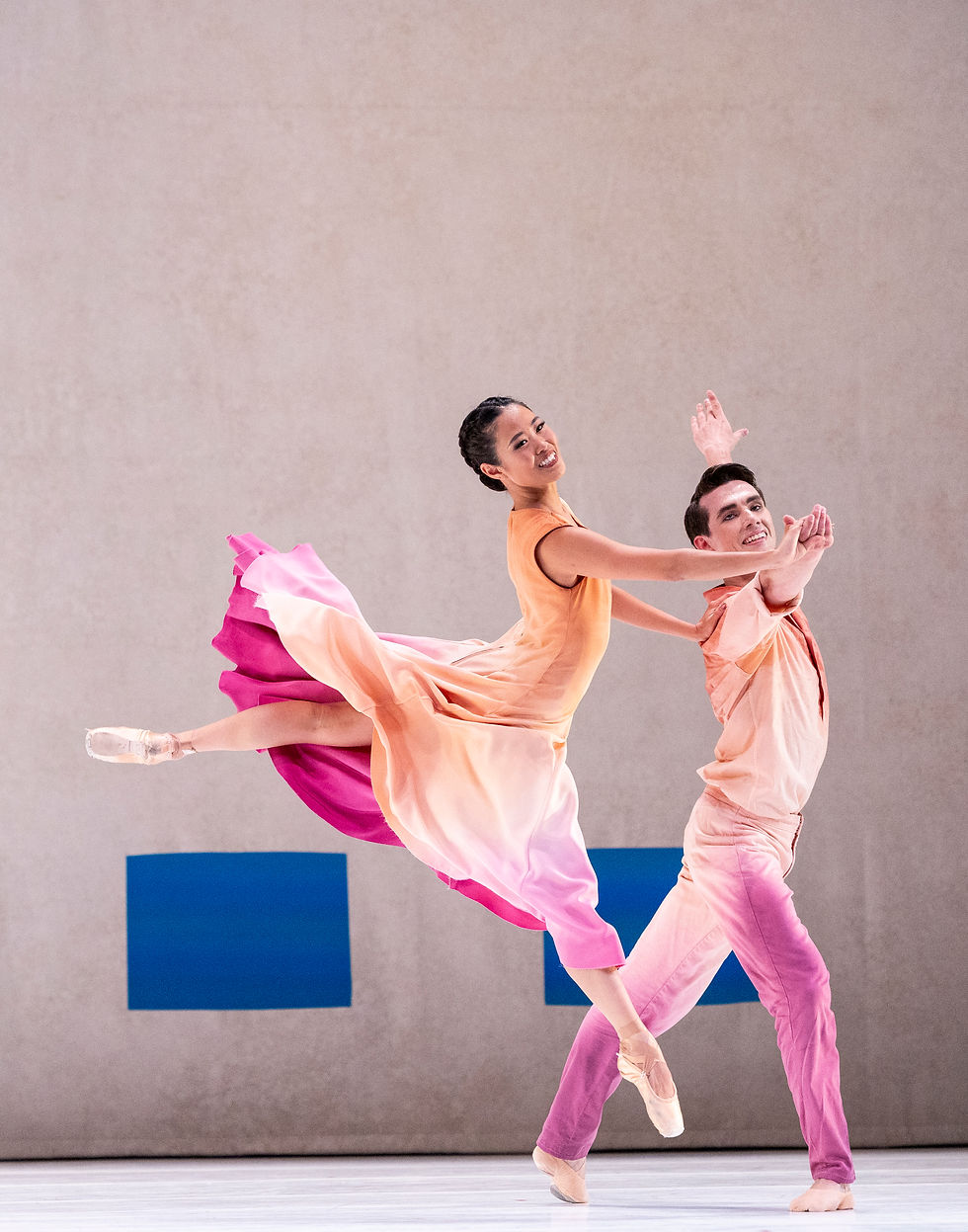
Jessica Lang’s set design for Her Door to the Sky places that rectangle as the central image, yet the wall, adorned with eight additional windows near the ground, is not a reddish brown as in O’Keeffe’s paintings, but rather, a whitewashed, clean expanse that captures the bright spaciousness of her work as a whole. Upon that canvas, the ombre hues of Bradon McDonald’s swirling, vibrant costumes create a physical embodiment of the light and color that characterize O’Keeffe’s paintings.
The score by Benjamin Britten further spins the airy atmosphere that spurs on the lively nature of Lang’s steps. Britten’s 1934 “Simple Symphony” is based entirely on a stockpile of themes that the British composer wrote between the ages of nine and twelve. Despite this, it has a mid-century feel and brims with country folk tones, full of pizzicato delights and nimble accentuations. The third movement samples a Christian hymn, “How Great Thou Art”, which may explain why this section of the work feels mysteriously sacred when swelled with Lang’s steady deliberation.
To capture the nature of visual art in physical movement is no easy feat, yet in the clean balance of elements, the sense of light and color, and the steps that erupt with their own whim, Lang paints the spirit of O’Keeffe’s work. Sweeping, arching port de bra (as in one lovely moment where a canon of arms in fifth repeatedly arc across the sky like flowers following the sun) and a plethora of rounded limbs brushing the dear earth and sky, echo O’Keeffe’s forms. Often spatially and rhythmically separated to recall the clean spacing of O’Keeffe’s work, dancers build a lively energy in folk-like prancing and a burst of rhythm, as delicate footwork spurred on by flighty strings pricks the soil and settles into a soulful refrain. Like O’Keeffe’s work itself, Her Door to the Sky contains ancestral forms and a newly-born, fresh-eyed refinement beneath Nicole Pearce’s New Mexican sunshine.
And such light falls upon a host of golden visions: Lily Wills’ willowy lyricism, Madison Rayn Abeo’s airiness and deliberate hand placement accenting all the bright beauty, Zsilas Michael Hughes hanging suspended in the air a breath longer than seems possible, and in the ease-filled flight that barely seems to touch the ground, Kuu Sakuragi finding the glee of a speed junkie, dashing through like a flicker of light.
Unfolding as a time-suspended dream, Her Door to the Sky gifts us the spaciousness and time to savor Elizabeth Murphy’s final days upon the stage. The central role of the work was created on her a decade ago, and in the way she inhabits its inner life, one can tell that it was molded to the purity of her movement. This dark third movement of the work, sentimental in its orchestral swell, is where Murphy’s pristine focus reveals her tender evocations to be not only a portrait of O'Keeffe the artist, but of Murphy as well. Perhaps it is the portrait of any artist, turmoiled cares and all. Saturated with sunset hues and filled with reverence for the gesture of her being, she is alone even when surrounded by five men who catch her falling cresting waves in some profound unraveling of being.
In the fall of 2020, Jessica Lang was the first choreographer commissioned to create a work for PNB’s digital season in the midst of the pandemic. To create in that perilous time, to declare that there must be a way to go on despite the circumstances, was a lifeline for artists and audiences alike. Nearly six years later, Ghost Variations is laden with remnants of the pandemic that shaped it, like an archaeological work whose walls are defined by what was necessary at the time. In a twist of fate, it could not exist in this form or with such cathartic necessity if the historical circumstances had not shaped it so.
The cloth dividing downstage from upstage originally allowed for a separation of the two pods of four dancers who were allowed to be in the studio together, but now resounds as nothing more than an ingenious tool to let shadow form an essential element of the work. Midway through, one dancer lies with her face covered upon the floor, originally positioned that way to protect her while two other dancers flurried nearby. But the greatest impact of the mandates at the time of creation is seen in Ghost Variations' spaciousness. Created in a studio taped into quadrants, the space between dancers and the lack of connection is a visceral separation that, in the ballet’s final moments, finds its reprieve when the only two dancers who were cohabiting at the time perform the work’s singular pas de deux. It’s a fascinating thing to think how circumstance can shape a work forever, and leave traces of its creation process in every crevice of its being.
Robert Schumann’s haunting 1854 “Ghost Variations” was his life’s final work, created shortly before being admitted to an asylum, and a work that he believed was dictated to him by the ghosts of Mendelssohn or Schubert. It was, in fact, his own theme that had come to him in the middle of the night, a melancholic mood that encapsulates the eerie stillness that filled Seattle during the creation of Ghost Variations. As Peter Boal worded it when reflecting on that grievous time, “There’s something about the return to what is so dear to all of us…it is possible, we are going to go on.” And so they did.
Despite the original story behind Schumann’s “Ghost Variations”, the angst of the pandemic fiddled its way into the ballet. It lingers in the atmosphere–a kind of hazy grief that floods that intimate space. Both from Schumann’s own state of mind (he attempted suicide in the midst of composing “Ghost Variations”) and from the uncertainty that 2020 brought, Lang’s work brims with human fragility.
This time around, in the work’s second live programming, another set of circumstances determined that the piano had no space in the orchestra pit and thus had to be placed on stage. Hopefully, there it will remain, for not only does its warm glow against the cold gray create a wonderful effect, but placing the piano onstage makes it seem like the dancers are born as the music’s own conjured ghosts.
A wide expanse cast in dim light–the piano’s faint light in one upstage corner, an ebony dark in the other–and there between stands a softened being, still and wallowed. Tender notes creep into the gray depths, and upon such wings, he comes into cautious motion. A familiar step into arabesque, only this is not the arabesque of expectations. It is empty somehow. Bent and flexed, hanging there as though not fully filled with life. Then a shadowed partner appears upon the wall, eerie only in the way that it belongs to no one in sight, yet pushes this dancer on his way and comes in and out of unison on a whim. A moment later, the shadow’s gone, growing tremendous as it departs straight through the proscenium.
Later, Reed Nakayama’s lighting extends choreography by way of five footlights that gift Kuu Sakuragi a ghostly corps de ballet of his own. As he moves in proximity to the lights, racing through a startling raw outpour, so do his five shadows separate and intercept each other until they become a veil painting of sorts. When Sakuragi flies, and five others fly just as high, it suddenly doesn’t feel like he’s the only one on stage anymore. In the end, four lights fade, and he’s left with one stark, singular shadow, abruptly alone.
Jessica Lang’s use of shadow in Ghost Variations is revolutionary. I’ve always found that a shadow upon the stage has the power to be gloriously haunting and metaphorically rich, but Lang takes the medium to new heights. A shadow is proof of existence, and oh, look at the form of this existence! To immediately know a dancer’s shadow as their own is a particular kind of beauty. In the present state of artificial-everything, the fact that these shadows are real, not pixels but glorious forms who are soon freed from one-dimensionality, captures an essence of humanity that we greet with near-relief.
The work’s intensity comes not from Robert Schumann, but from a scherzo by Clara Schumann, which burns with unrest and discontent. Here, Angelica Generosa, all quicksilver flashes of precision and release, finds the frenzied beauty in the rush of desperate limbs. Created on her in 2020, the role still feels deeply personal, as if she’s in conversation with that past self. Her vivid speed, the coil of her musical fingers, and the delicacy of the most minute details at such a pace are a moving proclamation.
As we’ve seen in Let Me Mingle Tears with Thee and in Black Wave, Sarah-Gabrielle Ryan fills Lang’s choreography with unbridled strength. In every flicker of physicality–limbs that push and crave and declare, pleading hands, and arms grasping for something they cannot find–what she spins there in the dim light is a ravishing and delicately carved truth.
Lucien Postlewaite carries the weight of Ghost Variations upon his heart from the beginning. In the inner stillness of the work’s first notes, quiet sophistication reveals itself to lie in the moments where spellbound motion draws its way through the thin light. If there’s one thing that stands out as a definitive gift of Lang’s work, it is her ability to give her flat dancers not just a pas de deux or some glorious show of prowess, but as here, the silence. The tender grief. An isolation of a soul who has no clue we’re there. A breath that lifts the whole being, as it does with Postlewaite, and lingers there, haunting.
One glorious moment I wish we could freeze eternally: Dylan Wald dashing from the wings to join Postlewaite and Christopher D’Ariano in ever-more hungry, soaring bounds across the stage, with the fervor of a pack of light-on-their-feet wolves. That trio, moving synchronously through Lang’s punctuated flight and spiraled unease (including an elbowed kneel that reverses itself so smoothly that it looks like a video running the wrong way), is a pairing I wish we had time to see more of.
Woven into Robert Schumann’s Ghost Variations are two pieces by Clara Schumann that intersperse her husband’s compositions. Brilliantly, the final selection, “Mondnacht” (Moon Night), composed by Robert and transcribed by Clara for piano, lets their collaboration serve as the score for the work’s only moment of physical connection.

With the rise of the curtain dividing the stage, separation is gone, and there, in deep darkness, two puddles of light and two souls converge. This pas de deux would not exist had it not been for the circumstances that allowed Elle Macy and Dylan Wald to find the solace of connection in an otherwise rather desolate scene. Thank goodness, for in a work filled with stark, once-mandated distance, their contact is a visceral relief.
Even in silhouetted form, the magnitude of Macy and Wald’s movement–steadfast carriage, definitive purpose, and wing-like port de bra–is a magnetic sight. What has always defined their work is presence, and when they dance together, all else fades away. Breaths fall into a timid, raptured stage, and there before us, in a seamless ebb and flow of cathartic release, they are endlessly intertwined even when distance falls between them.
It has been nearly exactly a year since Macy and Wald danced together upon this stage, a breadth of time that makes their glorious sweep through black infinity resound with a flood of inner necessity. The world that they enter together is so far from our own. Far from the theater, far from thought or anything that came before; there is only the relinquishment to the moment they share, and the heavenly spell of such focused intention.
They are poets of visceral gesture and breath, who let each wilting melancholy fall in waves of profound gesture. And oh, that final melting crawl to the floor with Macy draped across Wald’s back until the line between them is utterly blurred, is a verse of poetry that words could never emote.
Such transcendence lingers. Curtain falls, lights rise, chatter climbs, and yet, like a ghostly vision itself, some essence of that tender give or take, that sacred devotion that obscures time and thought, has not vanished. Still, it lives.
You’d be hard-pressed to find a more extravagantly fun way to end a season than with Lang’s ZigZag. Created in 2021 for American Ballet Theatre and set to ten songs by Tony Bennett, the jazz-driven work bursts at the seams with the power of dance to brighten and cheer and help us carry on. It would be easy to compare ZigZag to Nine Sinatra Songs by Lang’s former director, Twyla Tharp, but Lang’s tribute to Tony Bennett is more structurally cohesive, stylistically diverse, and exhilarating in its visceral delight. ZigZag relies less on nostalgia to sustain itself and makes Bennett’s melodies feel brand new while seamlessly blending an endless amount of dance genres.
Tony Bennett’s acapella “When I Lost You” bites into the still-lit theater, ringing with sentiment. But a moment later, at the curtain’s rise, the exuberance of life surging through the brightly clad cast of fourteen dancers is nearly overwhelming in its optimism. Lang has chosen a host of hits from Bennett’s career that are not only invigorating in their thrill, but that create a cohesive and hopeful picture of humanity. As the lyrics “What the world needs now is love, sweet love” resound through McCaw Hall, aligned with a stage full of synchronous arms-wide-open flight, it feels as though dance could change the world with such a potent rush of zealous energy.
On the tail of such zeal, “(I Left My Heart) In San Francisco” is a soul song that seems destined to fill Dylan Wald’s limbs. It’s been a terribly long time since we’ve seen him soar in a work of such pristine individuality, and this sentimental vision is an overwhelming reminder of the meditative state that he falls into when he comes into motion. He embodies Bennett’s voice like it is his own, so firmly centered and focused that he stretches every moment to its fullest capacity.
While the corps de ballet builds skylines and symbols behind him (though we can’t tear our eyes away to fully take this in), simply the way that Wald shapes Lang’s gestural details, like the twirling fingers strung along Bennett’s “little cable cars”, is filled with tremendous purpose. When Wald comes into motion, it’s like he doesn’t even know there’s an audience there to witness the perfect reach of each ease-filled, longing limb. There is not a single drop of ego in the maturity that radiates from his striking presence. Instead, only intuitive unfurlings of eagerness, and a deliberation that makes his charm unreplicable in its purity.
One of the highlights of the entire night is watching Angelica Generosa, Sarah-Gabrielle Ryan, and Noah Martzall have the time of their lives in “Fascinating Rhythm”. Days later, the ridiculous amount of delight packed into Lang’s social dance vernacular still has me grinning like a fool, for she has taken every perfect twist and wonderfully absurd vintage gesture and made it fresh. But of course, such a perfect design would be nothing without dancers who go the extra mile to overflow each contagious delight with character. “Fascinating Rhythm" could not have been better cast, and watching these three sink into every molecule of lark reminds us that ballet dancers really can do just about anything.
“Spring in Manhattan" is all the timeless elegance of Elizabeth Murphy sweeping through an evening’s blue. Simply watching her draw up to sous sus, with a breeze passing through her limbs, is a breath-stilling delicacy that could fill the whole evening if she’d let the contented freedom roll on.
Lang uses Bennett and Lady Gaga’s “De-Lovely” to let gesturally tied gestures and a vintage Broadway spirit weave a darling pas de deux. The lovely pairing of Angelica Generosa and Christopher D’Ariano is stocked full of boundless charisma and vitality, which nestles jazz accents into classical phrases (a jazz-hands bluebird lift!) with a natural flair.
In “Just One of Those Things” and “It Don’t Mean a Thing”, Lang places the corps de ballet center stage to remind us that rhythm is our life’s driving force. With Melisa Guilliams’ blindingly quick chaines turns, Emerson Boll as a human helicopter that seemed to fly higher with every show, and Kali Kleiman’s “worm”, the exhilarating speed, not to mention stamina, of such bright-eyed versatility is a treat.
After seeing ZigZag, you’ll never hear these Tony Bennett classics the same way again, for Lang give his words new color. The only question is, why did it take nearly five years to bring this masterful work to Seattle? It is not just a brilliantly good time, but impactful in both its darker shadows and its vibrant optimism.
“How do you keep a song from fading too fast?” Bennett sings in the ballet's final moments, and indeed, with only a few more precious days before this season finds its close, such sentiment swelled McCaw Hall. At the end of such an invigorating evening, no one could possibly argue with Lang’s assertion that "It is essential that art remain at the forefront of humanity.” How else can we carry on?
If you know what's good for you, you'll head to McCaw Hall to catch some very neccessary sunshine before it slips away on June 7th!


Comments